> For the complete documentation index, see [llms.txt](https://manual.unosofbooks.com/llms.txt). Markdown versions of documentation pages are available by appending `.md` to page URLs; this page is available as [Markdown](https://manual.unosofbooks.com/accounting/sri-electronic-transfer/sri-electronic-management/invoices-used-outside-unosof.md).
# Invoices Used Outside UNOSOF
This page describes how to skip sequentials inside of the SRI module, whenever we want to use those SRI IDs elsewhere. You can also find in this page, how to re use those sequentials.
{% hint style="success" %}
Home/ Accounting/ SRI Electronic Transfer/ **SRI Electronic Management.**
{% endhint %}
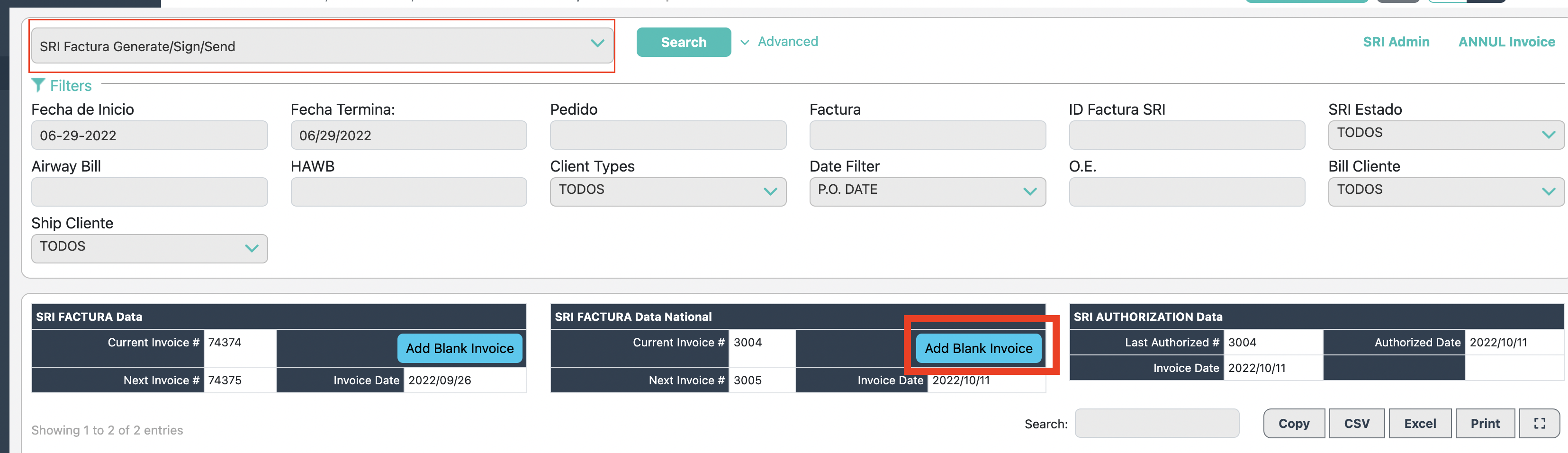
The option ADD BLANK INVOICE button, it is used to skip a sequential (SRI Invoice ID) and use it in another (accounting) system where it is necessary to use the numbering (sequential) for both export and national.
#### Example
You want to skip the sequential 3005 of the batch of national invoices, for the sale of a Vehicle
**Step 1:** Press the Add Blank Invoice button (appears only in the SRI/Invoice/Generate/Sign/Send module)
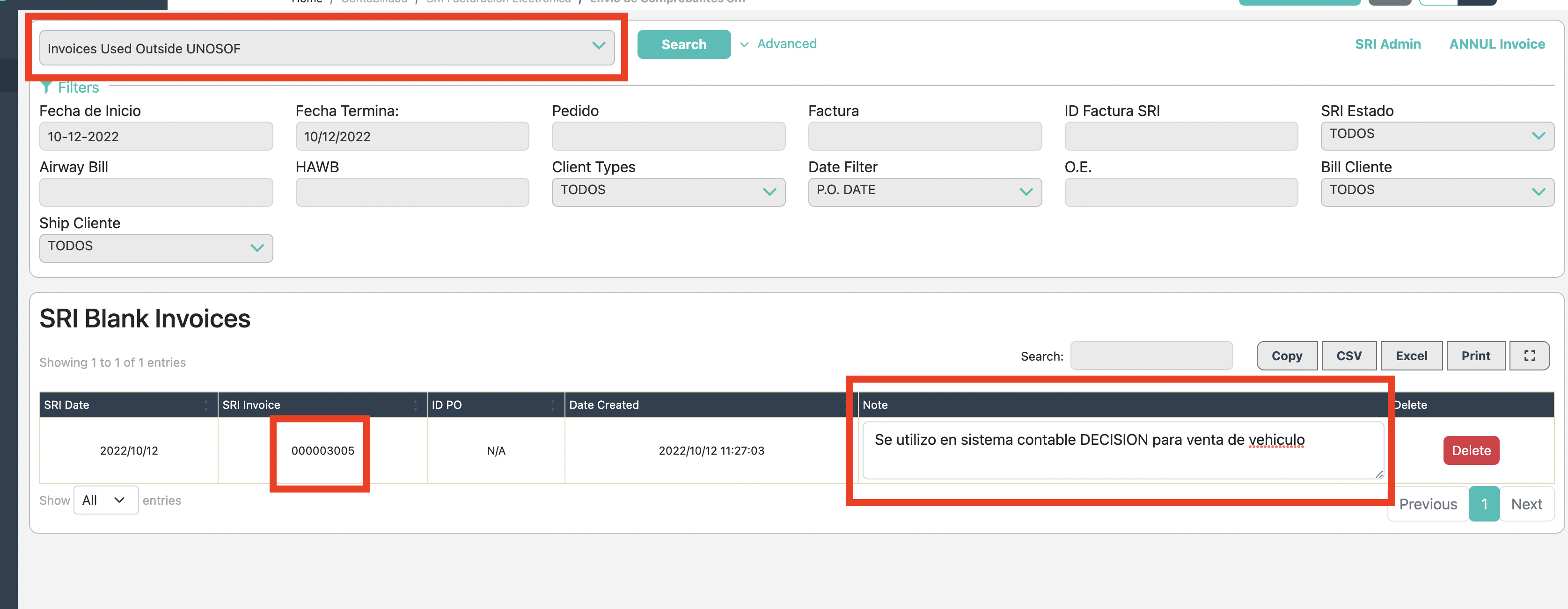
**Step 2:** Check in the module: **Invoices Used Outside UNOSOF.** You will see the 3005 sequential is skipped.
Step 3: An informative note can be added in the NOTE field
## Return a Sequential to use it in UNOSOF
By mistake, the sequence could have been skipped, with Add Blank Invoice.
We will use the same previous example: return the sequential of the National lot 3005 to the SRI Invoice IDs**.**
{% hint style="info" %}
This option works when the skipped sequence is the last one AND the following sequences have not been used yet.
{% endhint %}
**Step 1:** The skipped sequence (3005) is no longer available, and can be verified in the ADD BLANK INVOICE segment (national)
**Step 2:** Find the sequential (3005) in Invoices Used Outside UNOSOF
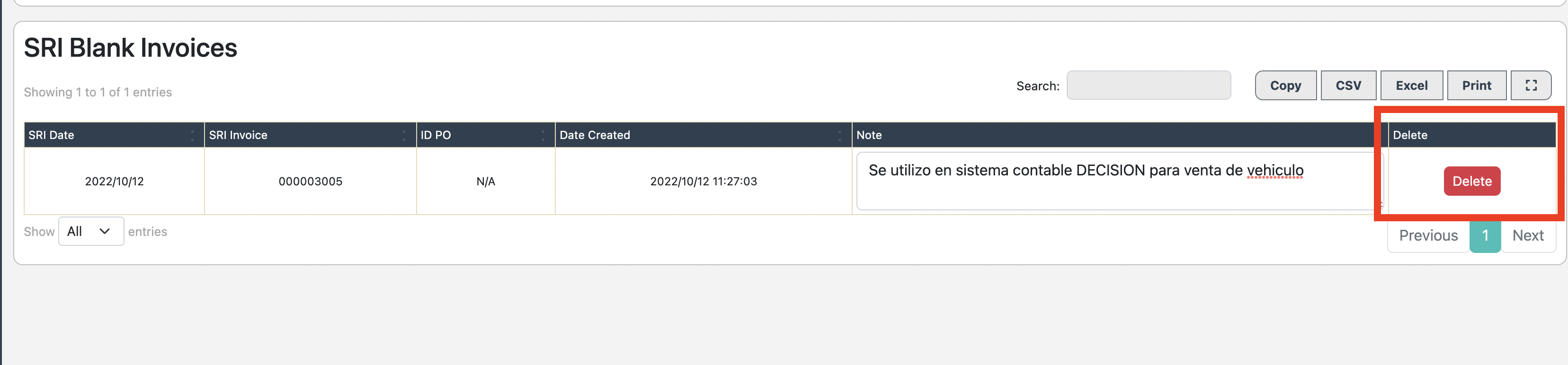
**Step 3:** Press the DELETE button to delete that skipped sequence, and return it to the SRI-XML generation module
**Step 4:** Check if the sequence is available again, in the SRI-XML generation module, Add Blank Invoice (national) segment
## Return a sequencial to use it (when it is not the last sequence )
You should follow the same steps of the previous option, but the sequential will be available in the option: **Unused (Skipped) Invoices**, since it is not the last one, for example the sequential 2989 instead of the last one 3005.
The steps can be found in the following manual:
{% content-ref url="/pages/-M3qdZE-RvKLxQQ7-1Wq" %}
[Unused (Skipped) Invoices](/accounting/sri-electronic-transfer/sri-electronic-management/unused-skipped-invoices.md)
{% endcontent-ref %}
.png?alt=media&token=941bab51-e0ac-4034-b8d3-ef5b69e6ce3f)
.png?alt=media&token=a58f3947-9d18-4c90-b93f-5ffb50b26fe9)
.png?alt=media&token=c51734bd-a83d-4788-a589-748e4733444b)
.png?alt=media&token=747c71fc-f465-4ec7-8d06-9f2a953a9b7b)
.png?alt=media&token=c3cff629-6159-4b4b-a33a-a84a9b9bc097)